

Kinaesthetics Infant Handling: Why the Right Movement Matters So Much for Your Baby
How you pick up, lay down, change and carry your baby shapes their sense of their own body from the very start. Kinästhetik Infant Handling, often called baby handling or infant handling and known internationally as kinesthetic infant handling, helps you support natural movement patterns, reduce stress and strengthen your bond. In this article we'll show you the basic principles and practical holds for everyday life, and explain why gentle side rolls and 3-step positioning are so valuable.
What is kinesthetic infant handling?
Kinesthetic infant handling goes beyond “lifting the right way.” It's a dialogue of movement and touch between you and your baby. Instead of moving your little one passively “from A to B,” you shape each transition so your baby can actively take part, at their own pace and within their natural development.
Quick definition & how it compares to “baby handling”
Kinesthetics means the perception of movement. With babies, it's about using touch and movement with intention: with broad, whole-hand contact, guiding the movement and always working through contact zones (such as the shoulders and pelvis). “Baby handling” is the everyday term for it. The idea behind it stays the same: communicating through touch and movement.
Goals & effects
The goal is to strengthen your baby's self-efficacy, support motor skills and body awareness, and reduce stress. Mindful transitions (for example, rolling over the side instead of “lifting straight up”) are less likely to trigger the Moro reflex and support calmer, more cooperative routines. At the same time, you strengthen your bond: touch releases oxytocin and helps ease tension.
Who is it for?
For everyone: full-term babies, preemies, babies who have trouble settling and self-regulating, and of course every caregiver in daily life. The approach is widely used in nursing care and early intervention, and it works just as well at home when you change, carry, breastfeed or put your baby to bed.
Core principles: awareness, adapting, mindful touch
Before we get practical, it's worth looking at the basics. These principles carry you through every situation, from the changing table to your evening routine.
Awareness of your own movement
Your posture and movement set the tone. Calm, deliberate hands, a steady stance and clear eye contact help your baby get their bearings and move with you.
Adapting to your baby's movement patterns
Follow your baby's lead. If they're looking to the right, start the roll to the right. If you feel them actively pushing off with their feet, use that impulse. That way, “being carried” becomes moving together.
Mindful, whole-hand touch
Place your hands flat and wide on your baby's chest, back, shoulders or pelvis. Guide the joints and head along for as long as possible instead of “grabbing” at single points. This feels more secure and makes it easier for your baby to regulate tension.
Working with reflexes instead of triggering them
Gentle side rolls and well-prepared transitions help avoid startle reactions (the Moro reflex). At the same time, you use your baby's built-in reflexes as an “engine” for movement instead of working against them.
Hands-on: how to move your baby in everyday life
Here you'll find concrete, tried-and-tested sequences for typical situations. The goal: secure, low-stress transitions in which your baby can actively take part.
Picking up over the side (instead of “lifting straight up”)
Prepare your baby with eye contact and a calm voice. Place one hand on the chest and shoulders, the other on the back and pelvis. Slowly roll your baby onto their side, guide the head along your forearm and let them “arrive” upright and close against your upper body. This keeps the tension evenly distributed, and your baby can brace and turn with you.
Laying down over the side
The way back works the same way: from the carrying position, roll your baby through side-lying onto their back or tummy. A brief, gentle “you've arrived” signal (containment), such as a calm, flat hand on the breastbone, gives your baby a sense of security.
Tear-free diaper changes
Instead of pulling the legs up, roll your baby onto their side. This is gentle on the hips and spine and invites your baby to join in: bracing, grasping, following with their eyes. Wipe and change the diaper while your baby lies on their side, then roll them back.
Breastfeeding & feeding with contact
Here too, make transitions over the side. Support the shoulder girdle and pelvis, and respect your baby's head control. This way, many babies find the breast or bottle more easily, stay calmer and drink with more focus.
Building up tummy time gently
Start from side-lying and let the forearm serve as a headrest. Offer small prompts for pushing up on elbows and hands. Your baby decides how much activity they want to take on today.
Carrying & baby carriers: what to look for
Look for ergonomic basic positions (the M position with knees up and legs apart, face toward you, shielding from stimulation). Many experts advise against forward-facing carrying (sensory overload, unfavorable pelvic alignment). What matters most: contact, support and calm transitions.
Easing sleep transitions
From your arms to the bed via side-lying: first let your baby “arrive” on their side, then roll them into the position you want. A quiet, steady rhythm, such as gentle swinging, closeness to your heartbeat or white noise, helps smooth the transition.
“3-step positioning for babies”: a safe sequence of positions for everyday life
3-step positioning is a sensible order of positions and transitions that give your baby stability and help build their movement skills.
What does “3-step positioning” mean?
At its core, it means practiced, recurring transitions between lying on the back, on the side and on the tummy, and back again. It is meant as everyday guidance, not a rigid program.
Why does it make sense?
It protects the hips and spine, reduces startle reactions and invites your baby to take an active part. Repeated, predictable transitions give your baby a sense of security, and babies learn to join in.
How to practice the 3 steps in everyday life
When you change a diaper, roll your baby over the side. When you lay them down, go to the side first, then onto the back or tummy. When you pick them up from lying on their back, roll them over the side into the carrying position. Lots of small repetitions throughout the day are enough.
Common mistakes & corrections
“Folding up” the legs, pulling on an arm or leaving the head unsupported all create unnecessary tension. The alternative: guide with the whole surface of your hands, roll calmly and slowly, and support the head and neck as you go.
Common pitfalls and how to avoid them
A few small changes make a big difference.
- Lifting straight up instead of turning to the side → roll over the side whenever you can.
- Legs up during diaper changes → rotate to the side instead, which is gentler on the hips.
- Gripping at single pressure points → place your hands flat over a wide area and guide.
- Rushing without warning → eye contact and a calm voice, clear signals, take your time.
Reading your baby’s signals: feedback in seconds
Babies “talk” through muscle tone, gaze, breathing and sounds. Learn to read these cues and adjust how you move.
- Feeling good: soft shoulders, calm gaze and breathing, actively joining in.
- Overwhelmed: arching the back, turning away, rapid breathing, “pushing away”.
- Tip: build in micro-breaks, offer containment again, reduce stimulation.
The science and background in brief
There are several plausible ways in which kinesthetic handling works: touch strengthens bonding (oxytocin) and reduces stress hormones, and repeated, predictable transitions support motor skills and self-regulation. Early reflexes are not “switched off”. They are gradually integrated into more mature movements. As always, the quality depends on guidance, practice and the individual baby.
Our osteopath explains: turning to the side and natural uprighting
“How do I lift my child out of bed the right way?” or “What’s the best way to move my baby during a diaper change?” I hear these questions in my practice almost every day. And it’s true: from birth on, the way we move our baby matters a lot. Every time we pick them up, lay them down or change a diaper, it is a small movement lesson, and these movements shape a child’s body awareness and development from the very beginning.
Kinesthetics in “infant handling” refers to the ability to move babies in a way that supports their natural process of getting upright. Above all, it is about handling transitions mindfully, such as from lying on the back to lying on the tummy, or from the back into a carrying position. Instead of lifting the child straight up, you gently move them over the side. This sideways movement follows the body’s natural mechanics and is also gentle on the spine and intervertebral discs.
For parents, this means: in everyday life, try to always move your child over the side, whether you are changing a diaper, picking them up or laying them down. That way, your baby experiences movement sequences that match their natural developmental path. They can actively join in, help with the turn and build up their muscles step by step.
So pay conscious attention to these small movements in everyday life. They make a big difference. This is how you support the healthy development of the spine and muscles and give your baby a feeling of security and comfort.”
(Source: Henggeler, J. & Henggeler, U. (2006). Infant Handling: Kinästhetische Entwicklung von Säuglingen [Kinesthetic development of infants]. Springer. More information: Kinästhetik Deutschland.)
Takeaways: Turning over the side is gentle on the spine and intervertebral discs, invites your baby to join in and builds strength and coordination step by step. Many “small” transitions add up to a big effect.
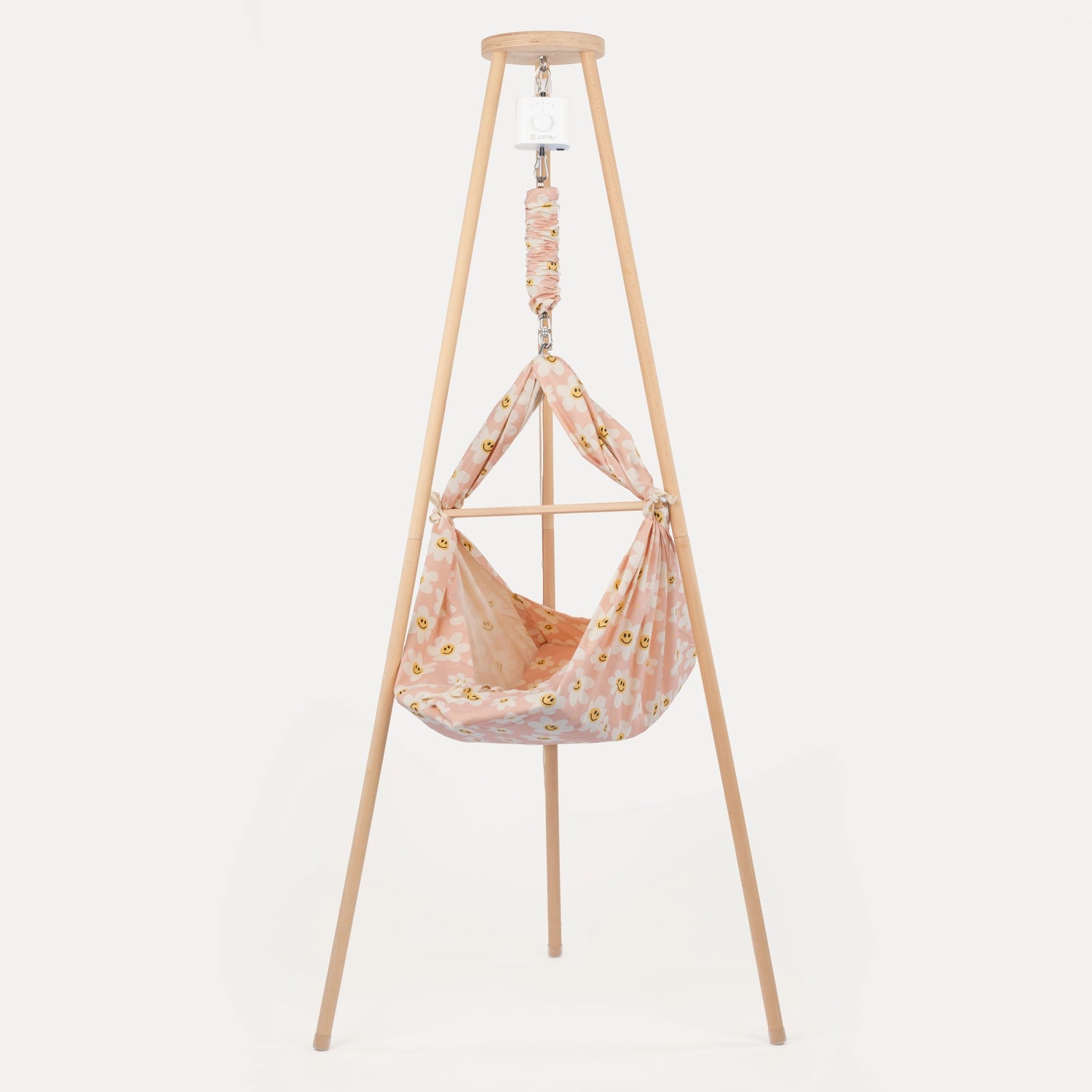
The Baby Hammock Set to Rent
Sleep for your baby, time for you.
Our set is also available to rent. Maybe renting is right for you!
Safety first: a safe setting for handling
Safety is the foundation here, not an extra.
- Setting: a non-slip surface, enough space, low stimulation.
- Hands-on: get your hands ready, always support the head and neck, never pull abruptly.
- Time: announce each transition, move slowly, match your pace to your baby’s signals.
- When should you get advice? If your baby keeps arching their back, shows clear asymmetries or seems very uncomfortable, talk to your midwife, your pediatrician or a therapist.
Step-by-step mini guides (to try yourself)
Picking up over the side: 5 steps
- Talk to your baby & make eye contact.
- Place your hands flat over a wide area (chest/shoulders, back/pelvis).
- Roll slowly onto the side.
- Support the head with your forearm as you go.
- Bring your baby upright close to your body and give them a moment to “arrive”.
Laying down over the side: 5 steps
- Stay close & let your baby know what’s coming.
- Lower your baby onto their side.
- Calmly roll them onto their back or tummy.
- Give a brief containing touch on the breastbone.
- Slowly take your hands away.
Diaper changes with side rotation: 4 steps
- Turn your baby to the side instead of pulling the legs up.
- Clean them while they lie on their side.
- Position the fresh diaper while they are still on their side.
- Roll them back and check the fit.
3-step positioning through the day: 3 sequences
Back → side → tummy (play/interaction) → side → back. Several times a day, short and relaxed.
A solution from Berlin: how our baby hammock supports your rhythm
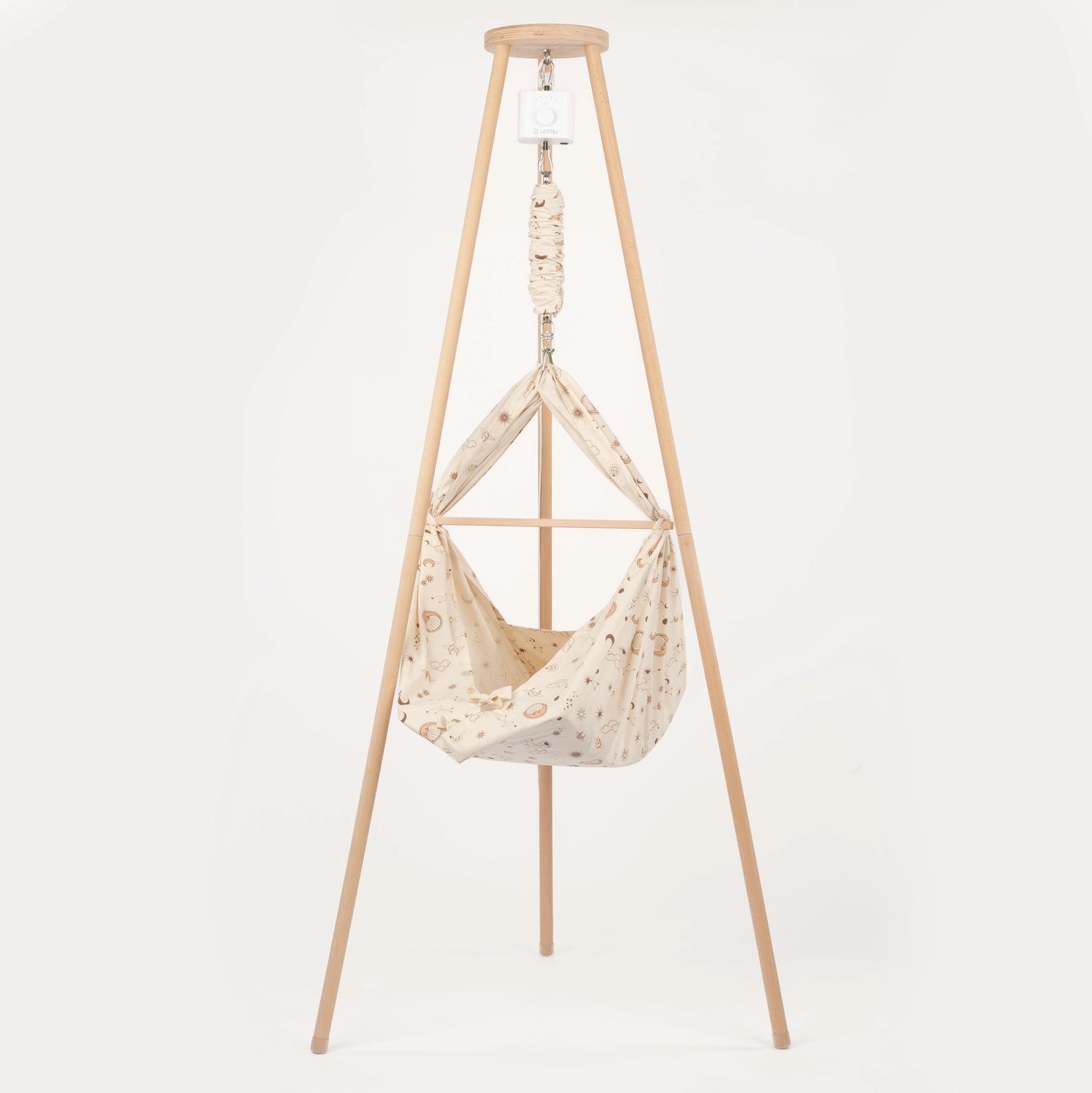
At Lottili, we want to make your everyday life easier. Our baby hammock complements the way you handle your baby. It does not replace it. The two work best together.
- Gentle, rhythmic transitions instead of “suddenly being put down”: the baby hammock offers a constant, predictable range of motion. Your baby relaxes more easily and can regulate tension better.
- Self-learning, whisper-quiet motor: it learns the rhythm you set, is continuously adjustable and energy-efficient. The timer (30-120 min) gives you flexibility in everyday life.
- Safety from the start: a safety rope made of climbing harness webbing, tested springs, and an automatic stop when the motion becomes irregular.
- Sustainable & beautiful: handmade stands of European beech wood and OEKO-TEX Standard 100 fabrics. Scandinavian, timeless and space-saving.
- Try it first, then decide: you can rent the baby hammock, flexibly and with no minimum term. Rental fees can be credited toward buying it.
More from us: Buy the baby hammock, White noise sleep aid, Baby sleep guide.
In short: small movements, big effect
Kinesthetic infant handling brings calm to your routines, strengthens your bond and supports your baby’s natural development, with no extra program, right in the middle of everyday life. Try one thing today: lay your baby down in bed by rolling them over the side first and watch how they respond. With a little practice, it soon feels completely natural.


